


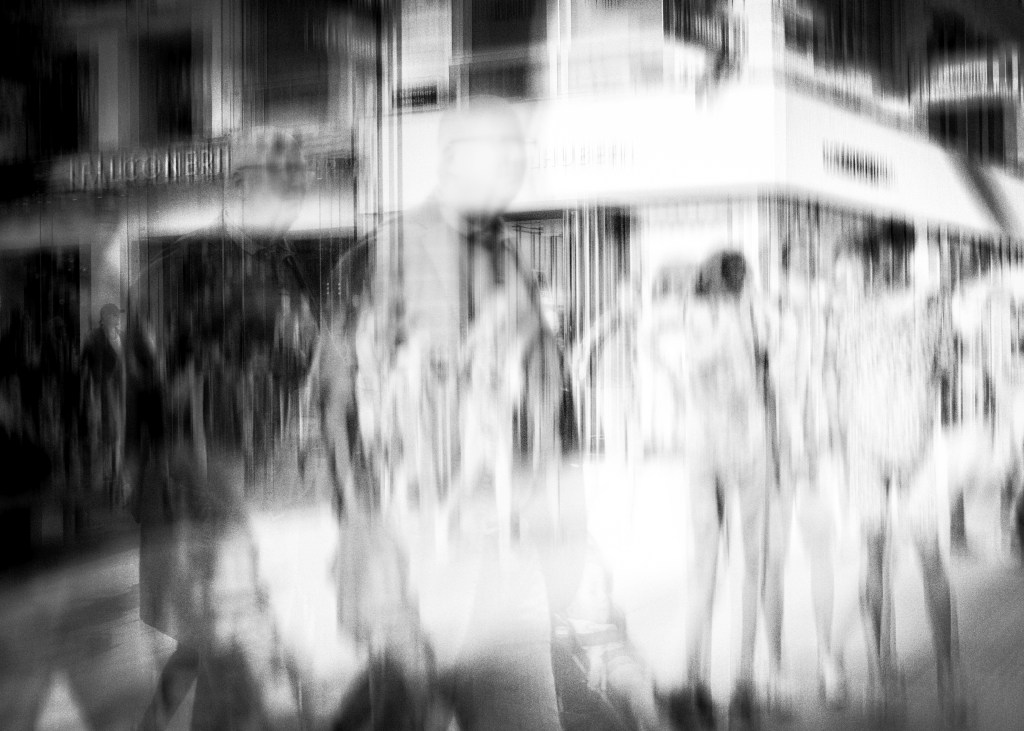
In Street Without Sequence, I approach the urban landscape not as a place of fixed coordinates, but as a fluid field of disappearance. The city here is not mapped, it is unraveled. Time does not proceed forward but collapses into layers: gestures, blurs, residues of presence. The photograph resists the assumption of chronology or sequence. There is no “before” or “after” in this image, only the persistent question of what remains when memory fails to settle.
Using extended exposure and deliberate blur, I’m not capturing motion in the traditional sense. I’m capturing its erasure, the way identity becomes unanchored in public space, how bodies turn to shadows before they’re even noticed. People appear not as subjects, but as ghosts of themselves, slipping across the frame like fragments of an interrupted narrative.
Architecture becomes the last witness, the unmoving container through which these half-lives flicker. Its permanence becomes a quiet foil to the impermanence of human presence. It is not the stage, but the trace-recording surface for what cannot be choreographed: the overlooked rhythm of a passing glance, the echo of footfall, the brief meeting of strangers whose stories are never told.
This is not documentation. It is visual archaeology, an excavation of time’s sediment, where each blurred figure is a glyph, each architectural repetition a temporal mark. What binds the image is not sequence or structure, but light, momentary, inconsistent, yet intuitively revealing.
Ultimately, this work exists between categories: between fact and sensation, body and blur, presence and vanishing. It is not a picture of the city. It is a portrait of what the city forgets to remember.
 BASSEM H. BOUSTANY Photography
Leave a Reply